Burned by Gas. WILMINGTON, Del., Oct. 23.—A woman residing on Market Street was severely burned on Saturday evening while attempting to light a gas lamp in her house. The gas had escaped from the burner, and when she applied a light it took fire, communicating the flames to her clothing. She was badly burned about the face and person.
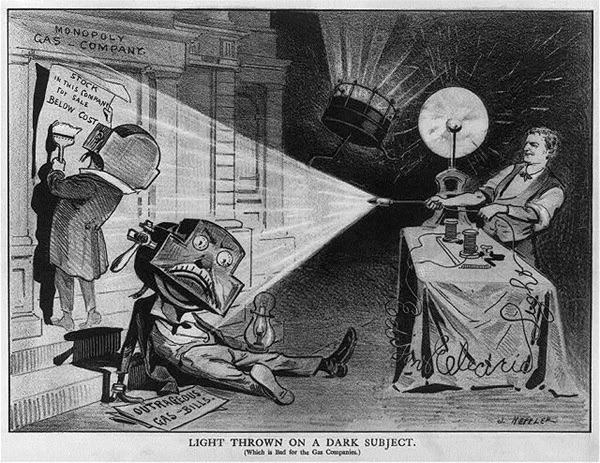
NEW YORK, N.Y., Oct. 27.—Recent foreign advices show that gas stocks were experiencing decline, in extreme cases as much as 12 per cent., upon the publication of alleged discoveries by Mr. Edison in the development of the electric light. It so happens that although the fact has attracted no general attention, there has been a very large decline in gas stocks here as well, as the following comparison shows:
Oct. 1
Sept. 1
Aug. 1
Jan. 1
July 1, 1877
Manhattan
160
180
185
210
190
New-York
70
91
90
120
130
Harlem
40
70
70
95
100
Mutual
70
80
72
95
100
Metropolitan
120
130
130
129
130
Brooklyn
140
145
145
155
155
Citiz’s of Br’kl’n
60
73
70
80
75
Nassau, Br’klyn
60
72
70
80
80
Baltimore
100
95
95
120
125
Boston
150
155
158
160
161
What gas companies have always been is a matter of common notoriety, public opinion having always held them as in the same category with plumbers. No monopoly could be more close, complete, and arrogant than theirs. For their franchises they paid nothing; the City, which gave them their opportunity for existence, they made their best customer, and, if they nominally owed it any dues, never paid them; they held to their territory most tenaciously; they furnished whatever quality of light they pleased, all test and regulation having been more pretended than real; they practically made bills what they pleased, for although the read off the quantity by the meter, that instrument was their own, and could be made to tell a lie of any magnitude; and the matter of regulating the pressure was always in their own control. Everybody has always hated them with righteous hatred, and not without reason; the very custom of exacting a deposit as security was evidence of this; for it meant not merely that the occupants of houses sometimes “skip” without pausing to adjust all their pecuniary obligations, but that if a person omitted to pay any bills at all, he would certainly begin the omitting with his gas bill. Yet—as the neighbor who wished to qualify the post-mortem condemnation of a very gad man by some sort of praise, remarked that, anyhow, he was a good smoker—we can admit one thing: That the companies always received “blowing up” at their offices with quiet, although sometimes exasperating, politeness; holding the “hand,” they could afford to let the other party use the bad language.
Their financial position has been, of course, bloated and altogether lovely. Water hardly collected more regularly and naturally than it did in their stocks, thereby swelling the nominal 10 per cent. dividends into a figure altogether more pleasant to the recipient but not more aggravating to the public, inasmuch as these little matters were never published from the housetops. In fact, the companies have always been modestly retiring in disposition, showing an unwillingness to be talked about in the newspapers, and not desiring to be heard of except by their messengers ringing the area bell on their rounds. The stocks have had a nominal, bid price, seldom altered, because the article seldom appeared in market, except “to close an estate”; if they were offered as collateral, it was between parties who knew all about them, and but seldom, for the owners were heavy men, who kept their affairs as tight as their little tin boxes, and had slight occasion to borrow on securities. Gas stocks, in short, have always been the embodiment of unctuous plumpness, quiet comfort, and eminent respectability.
But some change seems impending, for the decline shown by the above figures is much too heavy and swift to be accounted for by any considerations applicable to all sorts of shares. The desire to economize has somewhat reduced the quantity of gas consumed, but the use of kerosene has been a vastly greater interference. Notwithstanding the practical objections to its use, that fluid costs only one-fourth to one-third as much as gas at the present reduce price of the latter, even supposing that the slight reduction is not offset by an increase of pressure or a further lowering of quality. Scarcely anything has been done for many years to improve gas fixtures, either the burner or the so-called “shade”; on the other hand, inventors have been exceedingly busy upon the oil-lamp ever since the first petroleum excitement, early in 1865, and the arrogance of the gas companies has been practically capital for the dealers in lamps. Kerosene stores are now thickly scattered along all the avenues where retail stores abound, and during the last few years there has been an enormous abandonment of gas, both in this City and in Brooklyn, especially in the hundreds of small retail stores up town and back from the ferries, to which the bills for light have been a serious burden. Even in dwellings there has been a large displacement of gas; and, although the figures are not accessible to the public, the inroads upon the business of the companies must be very serious.
To this is added the threatened development of electric lighting. Some months ago, in discussing the Holly system of steam heat, we remarked that, in domestic economy, particularly in lighting and heating, there has been a marked lack of progress. We need light and heat in houses; we do not need to produce them on the spot from coal; and the process of cooking and heating, as at present conducted, is not less a nuisance because we are accustomed to it. Few persons are aware of the advantages of gas as fuel, even under present conditions. The we-known Bunsen burner, which mixes the gas with air before burning, thus making the mixture that explodes when a light is carried near a leak, produces a blue flame, so free from tase and odor that meat can be excellently cooked in direct contact with it without impairing the flavor in the beast. For either cooking or heating, gas has power enough, and its convenience is even greater than in producing light; the only obstacle to its constant and general use is the same which has kept inventors from improving the appliances—its prohibitory cost. But this is not necessary. Burning gas is about as abundant in nature as water itself; water itself will yield it, and although we cannot now enter into this matter minutely, we say unhesitatingly that it is practicable to furnish gas at a price which will banish the miserable abomination of stoves, furnaces, and ranges, with their dirt, labor, cost, fire-risk, and subjection to rule of Bridget. We do not say that the ability to do this is already attained, or that it is immediately at hand; but that the steps to reach it are few and not hard. As for the electric light, it is in the stages of development. The cost of the materials consumed in producing it is nominal, and in that respect it is incomparably cheap; but the methods of managing it need simplifying, and its glare must be greatly modified before it can come into use for ordinary purposes. At present, it is too concentrated and intense to be practicable, but it is only in its beginnings, and if the report be correct, that the problem of dividing it from one powerful light into many small ones has been solved, the whole difficulty is ready to be overcome. The gas companies, at all events, have reason for anxiety, and the time ought not to be remote when gas, steam, or electricity will enable us to banish coal fres and burn nothing larger than a match.
(The New York Times, October 27, 1878)
Farm Barn Burned. YORK, Penna., Oct. 27.— By the explosion of a can of kerosene, caused by bringing a lighted candle near the can while Mary Ann Wenger, a farm girl, was filling a lamp, the girl was burned to death on Thursday evening east of Red Lion. Two horses and a cow were likewise destroyed, and the flames, taking hold of the hay, soon consumed the barn.
Edison’s Newest Marvel—Sending Cheap Light, Heat, and Power by Electricity—Illuminating Gas to be Superseded.
NEW YORK, N.Y., Sept. 16.—Mr. Edison says that he has discovered how to make electricity a cheap and practicable substitute for illuminating gas. Many scientific men have worked assiduously in that direction but with little success. A powerful electric light was the result of these experiments but the problem of its division into many small lights was a puzzler. Gramme, Siemens, Brush, Wallace, and others produced at most ten lights from a single machine but a single one of them was found to be impracticable for lighting aught save large foundries, mills, and workshops. It has been reserved for Mr. Edison to solve the difficult problem desired. This, he says, he has done within a few days. His experience with the telephone however has taught him to be cautious, and he is exerting himself to protect the new scientific marvel, which, he says, will make the use of gas for illumination a thing of the past.
Mr. Edison, besides his power of origination, has the faculty for developing the ideas and mechanical constructions of others. He visited the Roosevelt pianoforte factory in this city, and, while examining the component parts off the instruments, made four suggestions so valuable that they have been patented. While in the mining district of the West, recently, he devised a means of determining the presence of gold below the surface without resorting to costly and laborious boring and blasting. While on a visit to William Wallace, the electrical machine manufacturer, in Ansonia, Conn., he was shown the lately perfected dynamo-electric machine for transmitting power by electricity. When power is applied to this machine, it will not only reproduce it but will then turn it into light. Although said by Edison to be more powerful than any other machine of the kind known, it will divide the light of the electricity produced into but ten separate lights. These being equal in power to 4000 candles, their impracticability for general purposes is apparent. Each of these lights is in a substantial metal frame, capable of holding in a horizontal position two carbon plates, each twelve inches long, two and a half wide, one half thick. The upper and lower parts of the frame are insulated from each other, and one of the conducting wires is connected with each carbon. In the center, and above the upper carbon, is an electromagnet in the circuit, with an armature, by means of which the upper carbon is separated from the lower as far as desired. Wires from the source of electricity are placed in the binding posts. The carbons being together, the circuit is closed, the electromagnet acts, raising and lowering the upper carbon enough to give a bright light. The light moves tower the opposite end from which it starts, then changes and goes back, always moving towards the place where the carbons are nearest together. If from any cause the light goes out, the circuit is broken and the electromagnet ceases to act. Instantly the upper magnet fails, the circuit is closed, it relights and separates the carbon again.
Edison, on returning home after his visit to Ansonia, studied and experimented with electric lights. On Friday last, his efforts were crowned with success, and the project that has filled the minds of many scientific men for years was developed.
“I have it now,” he said, on Saturday, while vigorously turning the handle of a Ritchie inductive coil in his laboratory at Menlo Park, “and singularly enough, I have obtained it through an entirely different process than that from which scientific men have ever sought to secure it. They have all been working in the same groove, and when it is known how I have accomplished my object, everybody will wonder why they have never thought of it. It is so simple. When ten lights have been produced by a single electric machine, it has thought to be a great triumph of scientific skill. With the process I have just discovered, I can produce a thousand—even ten thousand—from one machine. Indeed, the number may be said to be infinite. When the brilliancy and the cheapness of the lights are made known to the public—which will be in a few weeks or just as soon as I can thoroughly protect the process—illumination by carbureted hydrogen gas will be discarded. With fifteen or twenty of these dynamo electric machines recently perfected by Mr. Wallace I can light the entire lower part of New York city, using a 500 horse power engine. I purpose to establish one of these light centers in Nassau street, whence wires can be run up town as far as the Cooper Institute, down to the Battery, and across to both rivers. These wires must be insulated and laid in the ground in the same manner as gas pipes. Also propose to utilize the gas burners and chandeliers now in use. In each house I can place a light meter, whence these wires will pass through the house, tapping small metallic contrivances that may be placed over each burner. Then housekeepers may turn off the gas and send the meters back to the companies whence they came. Whenever it is desirable to light a jet, it will only be necessary to touch a little spring near it. No matches are required.”
“Again, the same wire that brings the light to you,” Mr. Edison continued, “will also bring power and heat. With the power your can run an elevator, a sewing machine, or any other mechanical contrivance that requires a motor, and by means of the heat you may cook your food. To utilize the heat, it will only be necessary to have the ovens or stoves properly arranged for its reception. This can be done at trifling cost. The dynamo-electric machine, called a telemachon, and which has already been described in The Sun may be run by water or steam power at a distance. When used in a large city the machine would of necessity be run by steam power. I have computed the relative cost of the light power and heat generated by the electricity transmitted to the telemachon to be but a fraction of the cost where obtained in the ordinary way. By a battery or steam power it is forty-six times cheaper, and by water probably 95 percent cheaper.”
It has been computed that by Edison’s process the same amount of light that is given by 1000 cubic feet of the carbureted hydrogen gas now used in this city, and for which from $2.50 to $3 is paid, may be obtained from twelve to fifteen cents. Edison will soon give a public exhibition of his new invention.
(The New York Sun, September 16, 1878)
Fatal Accident. NEWARk, N.J., Sept. 16.—Mrs. Sarah Jane Miller, of Hackettstown, lost her life yesterday by the explosion of an oil-can. While filling a kerosene lamp she held a lighted candle too near the spout, when the escaping vapor took fire and the can exploded. She was terribly burned and died shortly afterward.