Little Hope, Chapter 2

IMG_5075

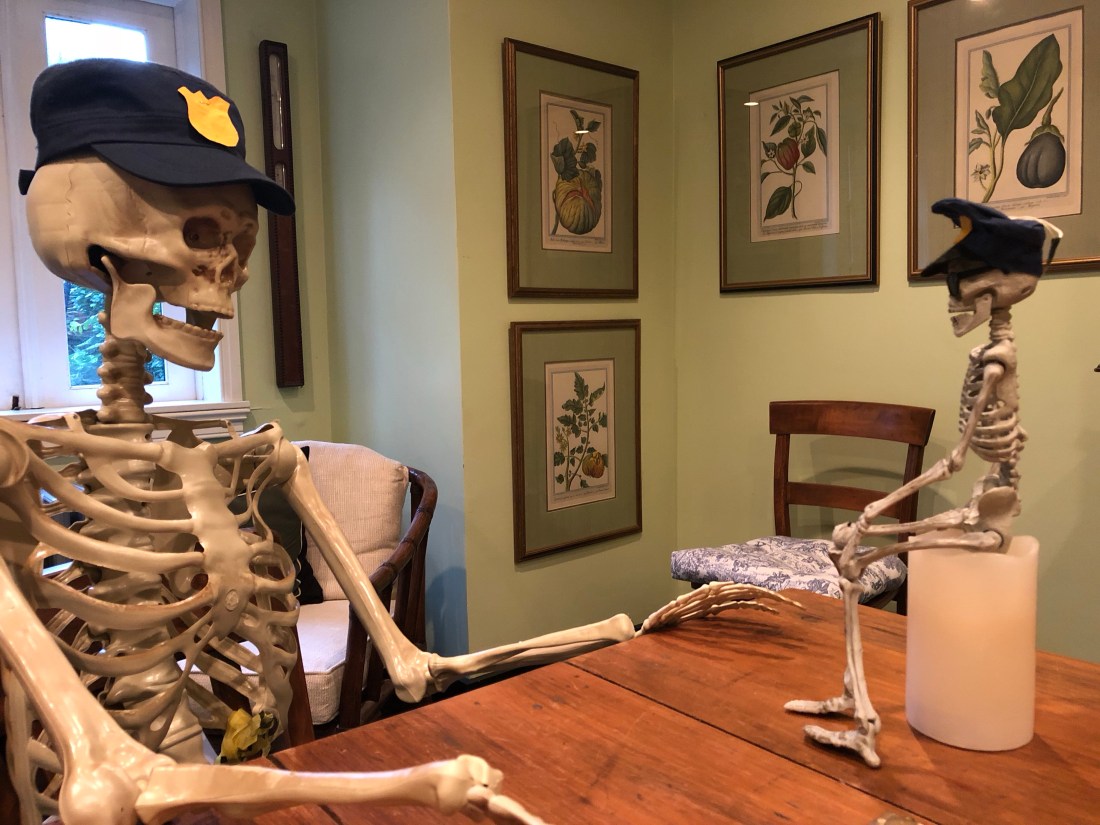
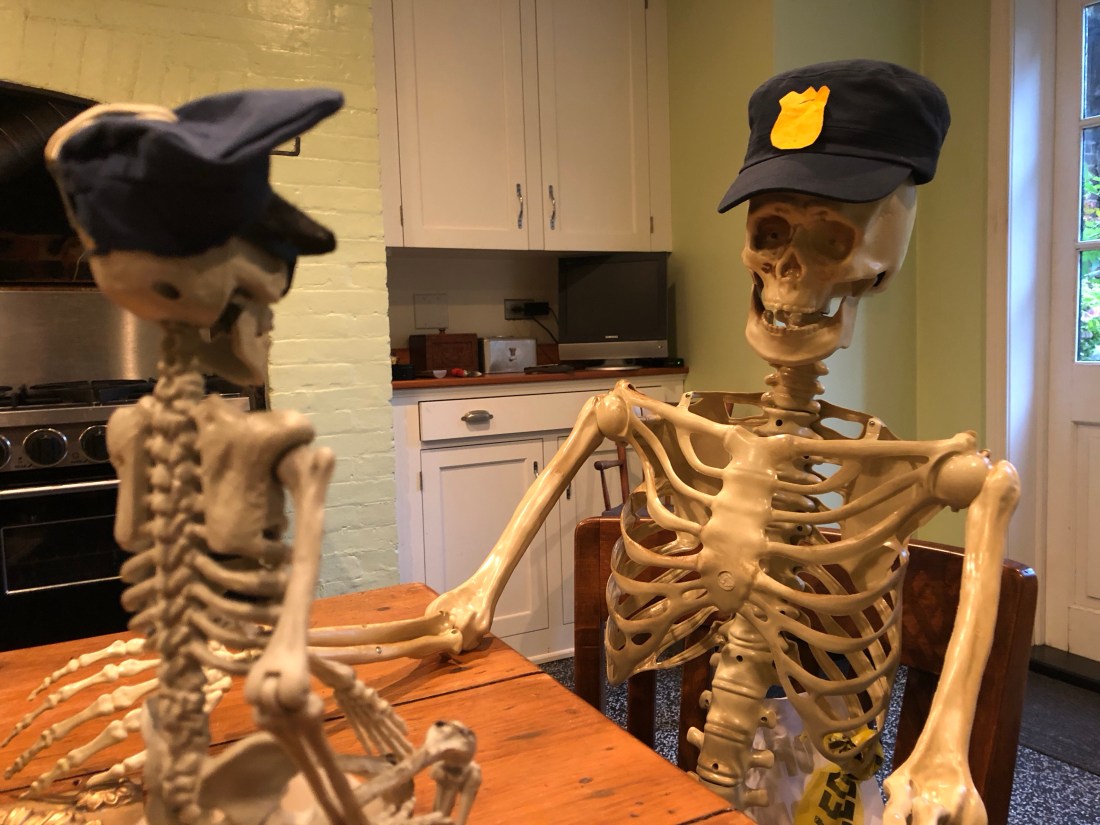
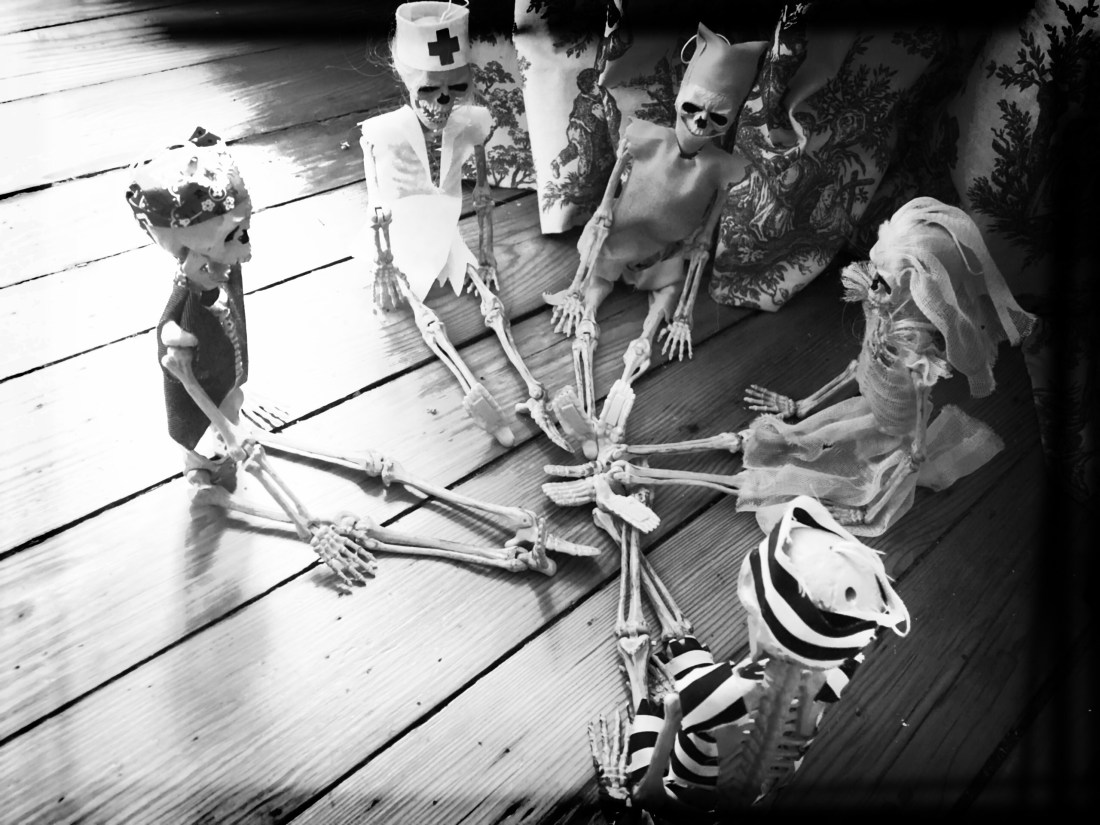
Little Hope broke up the symposium and returned the toy skeletons to the lidless wooden box in her bedroom. She had fourteen in all, including two big ones and a rat, and most of them had names. Among the little ones were Nurse Janet, Brad the Surgeon, and their daughter, Missy; Police officer Birdygo, Butterscotch Chip, Amazing Grace, and one elaborately dressed skeleton with unbendable elbows and knees named Chica. The big ones propped up in a corner of the room were Mr. Funny Bones and his twin, Funnier. She used the two of them as hat stands. The rat skeleton with googly eyes perched on the dresser was Butterscotch Chip’s sidekick, Dale.

Little Hope couldn’t take credit for any of the skeletons or any of their names. They’d all come to her prenamed from her dad’s best friend and former Best Man, whom she had always known as Uncle Mack. 

She loved hearing Uncle Mack retell the story about how he amassed his—to use her grandmother’s word—morbid collection of skeletons of different sizes in different costumes. It all started, he’d explain, at a local drugstore around Halloween, where he’d spied from the corner of his eye a full-sized, slack-jawed skeleton crouched on a bottom shelf with a tragicomical “Half Price” sticker on his frontal bone. The name, Mr. Funny Bones, came to mind instantly. “And just like that,” he’d say as he snapped his fingers, the idea of acquiring and naming skeletons was born.

Uncle Mack never could pinpoint what had inspired him to start posting photos of Mr. Funny Bones saying silly things or making puns about death on social media, but the response from some of his friends encouraged him to continue. One of his biggest fans was Little Hope’s mother, who saw something eerie yet appealing in his posts. She responded approvingly to every one of them with strings of emojis and likes to coax him into posting more. 

Over time, one skeleton led to another. Some he’d picked up from the same drugstore. Others came from farther away. He eventually moved on from one-off posts to stories, some involving costume and scene changes, household props, and complex plot lines. Uncle Mack would always tell Little Hope and her parents that by expanding his collection he was able to keep his stories fresh. And every time, her father and mother would try to get him to admit that he was lonely. If that were truly the case, Little Hope thought to herself, then why doesn’t he just get a girlfriend or a pet?

For someone of Little Hope’s disposition, Uncle Mack’s toy skeletons were the perfect charge. They didn’t require any food or water and didn’t need to be walked or let outside to go to the bathroom. Apart from the one named Butterscotch, whose left leg was flimsily attached to his pelvis with an upholstery tack because of some earlier injury, they didn’t need regular maintenance.

Although Little Hope felt confident in her ability to care for Uncle Mack’s morbid collection, she felt less sure about animating them. Uncle Mack had a knack for dreaming up clever captions and outlandish scenarios that seemed to reach beyond the creative limits of someone her age and experience. Unwilling to go out on a limb with her own skeleton puns and dramas and expose herself to ridicule, she opted instead to create symposiums and other opportunities away from the camera for the skeletons to communicate freely and independently among themselves.

The size and scope of the symposiums varied widely. Sometimes Little Hope would assemble small groups of little skeletons to discuss the major issues of the day, such as climate change and immigration. Other times, she’d pick a topic of local interest, such as the inclusion of bicycle lanes in state-funded highway projects. Every so often, the symposium participants would offer critiques and render judgments. Her mother’s wardrobe was a recurring subject. Once, she convened a group of the smartest skeletons to complete a crossword puzzle her mother had left unfinished. They didn’t get very far, not because they didn’t know the answers, but because they couldn’t hold the pen in their little boney hands. 

Whereas Uncle Mack had occasionally taken the skeletons outside for a photo shoot at a bus stop or in a canoe, Little Hope kept them indoors. She did so, she’d tell them, to keep them out of the crosshairs of Bruiser, the neighbor’s unfriendly and unpredictable dog. 

The big ones, Funny and Funnier, never left her room. One evening shortly after their arrival, she had overheard her mother tell her grandmother that she wasn’t sure she could ever forgive Uncle Mack. Little Hope figured she could get away with setting up the little ones in the corner of the family room or the kitchen every now and then without feeding her mother’s anger towards him, but Funny and Funnier, and even Dale the rat, were simply too large to escape her mother’s view. 
Little Hope, Chapter 1

img_5068

“Little Hope Lindberger, how many times do I have to tell you to put away those skeletons? You know how I feel about having them all over the house. The ones seated together over there by the window look like they’re having tea!” 

How absurd, Little Hope thought to herself. Everybody knows skeletons can’t drink. “They’re not having tea, Momma. They’re having a symposium.” 

Little Hope Lindberger was her name alright, or at least that’s what everybody’d call her. Her real name was Hope Ann Lindberger, and by the first grade she’d told everybody in Greenfield she was going to change it someday. Hope was also her mother’s name, which is why everyone from her grandmother on down called her Little Hope. 

Her mother went simply by Hope. When Little Hope’s father was in a playful mood, he’d tease his wife by calling her “My One and Only Hope!” Years before Little Hope was born, when her grandmother was exasperated with her daughter because of something boneheaded she had done, she’d refer to her disparagingly as “Our Great Hope.” “Well, Our Great Hope has done it again!” she used to exclaim before launching into the details of her daughter Hope’s misadventures. Little Hope loved hearing stories about those days long ago.

Ann was her grandmother’s name. For as long as Little Hope could remember, she had called her “Grandm’Ann,” not “Grandma Ann.” She liked the efficiency of eliding words, and to her whole family’s chagrin she practiced elision at every opportunity even though she sometimes had trouble remembering or pronouncing the word “elision” itself. 

“Man is right,” her mother’d say under her breath from time to time when Little Hope mentioned her grandmother by name. “Spot her early enough in the morning and you just might catch a glimpse of her mustache.” Little Hope would laugh every time her mother’d say that, but she’d also feel as though she was somehow betraying her grandmother’s trust by indulging her mother in such jabs. At the end of the day, Little Hope reasoned, she was helping maintain the balance of power between two important and necessary people in her life.

As for the family name Lindberger, it burdened Little Hope just as she assumed it had everyone else who’d been sentenced to carry it forward. She’d tried everything imaginable, from pronunciation to education, but her schoolmates would nevertheless continue to equate her family name with the smelly homonymic Limberger cheese and tease her about it. “People will hear what they want to hear,” her grandmother would always insist. But Little Hope herself would counter-insist: Lindberger was the name she was going to change. 

At least she wasn’t a Lively-Lindberger like her mother, Little Hope would sometimes think to herself in consolation. Lively was her mother’s maiden name. On holidays, around her grandparents’ dining room table,  the post-meal conversation would inevitably drift to that moment during Little Hope’s parents’ wedding reception when her father’s Best Man ceremoniously presented the wedding couple a tray of cheeses, some of them standing on end, hilariously brought to life with googly eyes and pipe cleaners for arms and legs. Her grandmother would always feign exasperation during that storytelling but eventually join everyone else around the table in boisterous laughter. 

Although conflicted about her family name, Little Hope could never resist the good humor and warmth radiating post-meal from the holiday table and would eventually join in the laughter, too. What a fun time, she’d think.

DOA, Epilogue

FabriziodellOsso

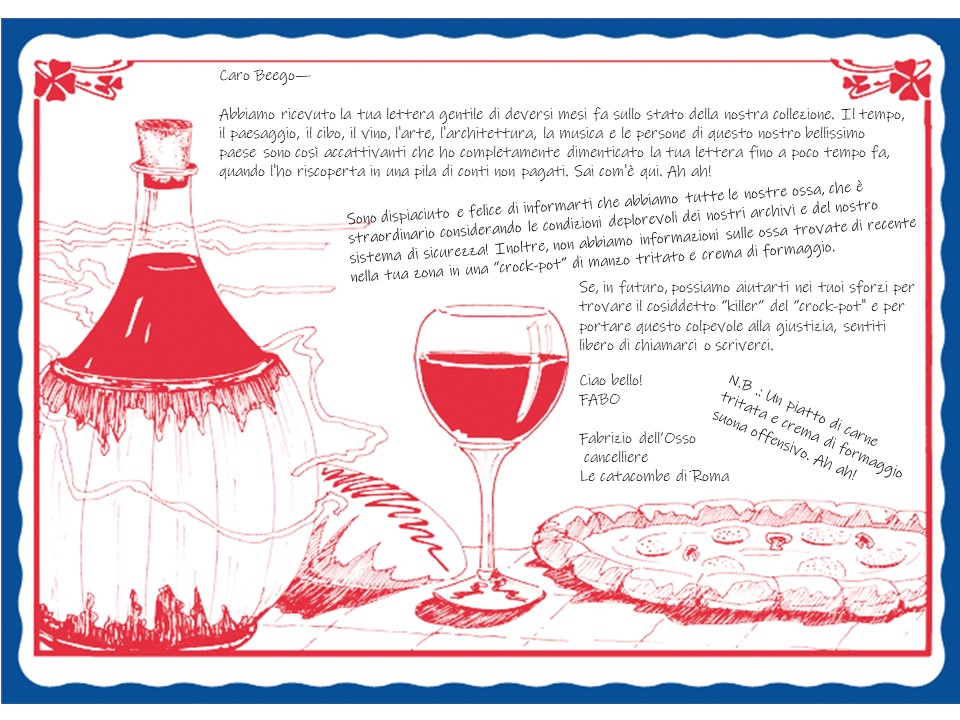
Letter on a placemat from Fabrizio dell’Osso

Reread Chapter 8

Dear Beego,

We have received your kind letter from months ago regarding the state of our collection. The weather, the landscape, the food, the wine, the art, the architecture, the music and the people of our beautiful country are so captivating that I completely forgot about your letter until recently, when I rediscovered it in a pile of unpaid bills. You know how it is here. Ha ha!

I am both sorry and happy to inform you that we have all our bones, which is extraordinary considering the deplorable conditions of our archives and our security system! Also, we have no information about the bones you recently found in your area in a “crock-pot” of minced beef and cream cheese.

If, in the future, we can help you in your efforts to find the so-called “killer” of the “crock-pot” and to bring this culprit to justice, feel free to call or write to us.

Ciao beautiful!

FABO

Fabrizio dell’Osso, chancellor
The catacombs of Rome

N.B.: A dish of minced meat and cream cheese sounds offensive. Ha ha!

DOA, Chapter 25

“Snap out of it, sir!”

“Huh? What? Who am I? Where am I? What am I? Sir, yes sir! Chief Birdygo Chip reporting for duty, SIR!”

BirdyMiyagi
Tropicamide causes Chief Birdygo Chip to hallucinate.

“Sir, you’ve drifted out of character! You’re not Mister Miyagi, I’m not your superior, and this isn’t The Karate Kid, sir! You are Chief Birdygo Chip, this is Dead on a Rival: The Case of the Crock-Pot Killer, a Mister Funny Bones Mystery, and you are about to reveal the killer’s identity!”

“Oh, right. Never go to work after a visit to the eye doctor, kid. The stuff they use to dilate your pupils messes with your head. Either that, or I fell off the candle, hit my head on the table, and the writer, even though he doesn’t know where to go with this side story, is having me mention it anyway because he thinks it’s funny. Now, where was I?”

“You were talking about illusory motion, sir.”

“Ah, yes. Struggling with the facts and the non-facts of this case, I retreated into staring at the words ‘Rival Crock-Pot’ for so long without blinking that in my mind’s eye the words changed order and I read ‘Crock-Pot Rival’ instead, just like in the accompanying video. At first I thought it was an urgent medical issue, which is why I went to see the eye doctor, you see. But then I realized that no, it wasn’t a medical issue. It was a clue!”

“Are you saying, sir, that illusory motion called out our killer?”

“Dead on, kid. That’s exactly what I’m saying. And that the killer of our crock-pot is none other than our crock-pot’s rival.”

“Do you mean?”

“Yes!”

DOA, Chapter 24

img_2329.jpg

“Reveal our killer, sir?! A killer in this town?! But that’s impossible! Skeletons can never die because we’re already dead.”

“Ah, yes, young grasshopper. That is true. And it is quite natural for us to dismiss the idea of there being killers and victims among us because they are not part of our own experience. But that doesn’t mean they don’t exist. Do you remember that letter from Paris?”

“You mean the one from Madame de Boneville at the catacombs, sir?”

“Yes, that one. Madame de Boneville referred to a ‘tueur du ‘crock-pot”–a killer of the crock-pot–because the rigid rules of French grammar do not allow her to construct compound nouns otherwise.”

Reread Madame de Boneville’s letter

“I don’t understand, sir.”

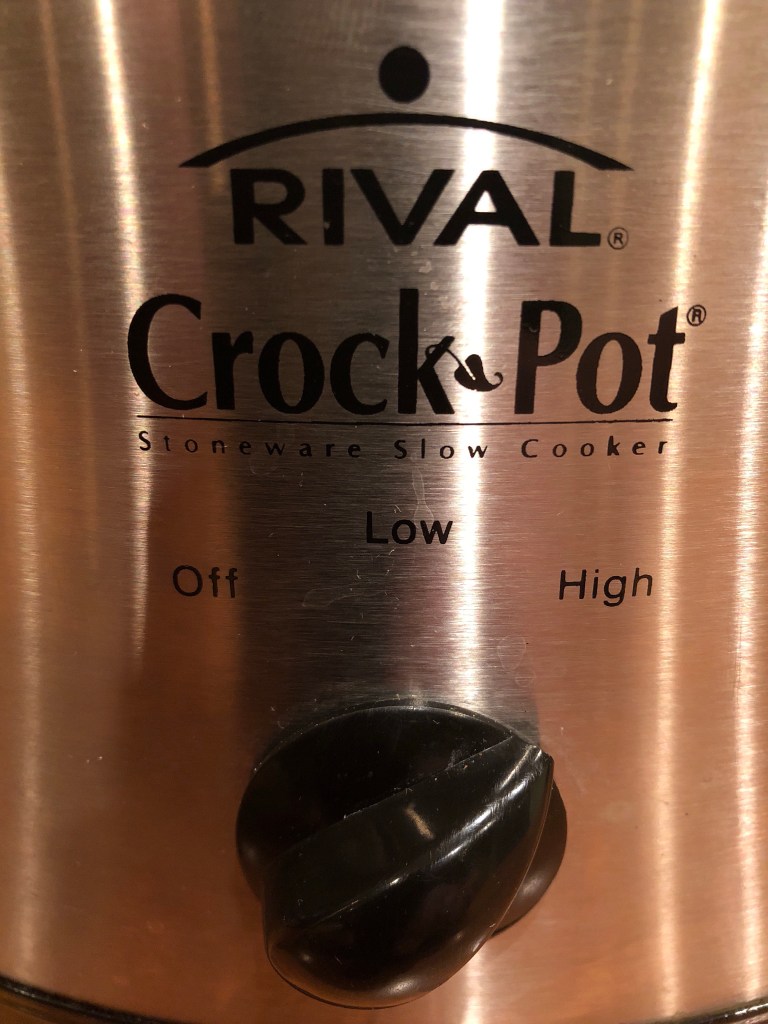
“I did not either, grasshopper, until with a clear gaze I reflected serenely on reality as Buddhism for Sheep advises, and like a divine revelation it became apparent to me that the crock-pot, not John Doe One or Two, was our victim. Though set on High, it was not hot. It could not be, for it was dead!”

0fb61ca3-b834-4481-8bc7-19a78d6227e6-8042-00000583423a7e38_file-1
Though set on High, the crock-pot was not hot because it was dead.

“Jeepers, sir! If that’s the case, who’s the crock-pot killer?”

“Ah, after much reflection and a fixed gaze upon our victim for a prolonged period of time, the answer to that important question became apparent to me as well.”

“How is that, sir?”

Illusory motion, grasshopper.”

DOA, Chapter 23

img_2337

“Gosh! Do you really think those teeth marks on the femur are Dale’s, sir?”

“I’m positive, kid. What do rats do? They get into your garbage. And Dale had the perfect opportunity to grab that leg while all the Chips were down for the filming of The Clipopalypse. He’s not a Chip, and no one was around to see him.

“But, sir, why would Dale have dumped the leg in the crock-pot of creamy chipped beef and cheese?”

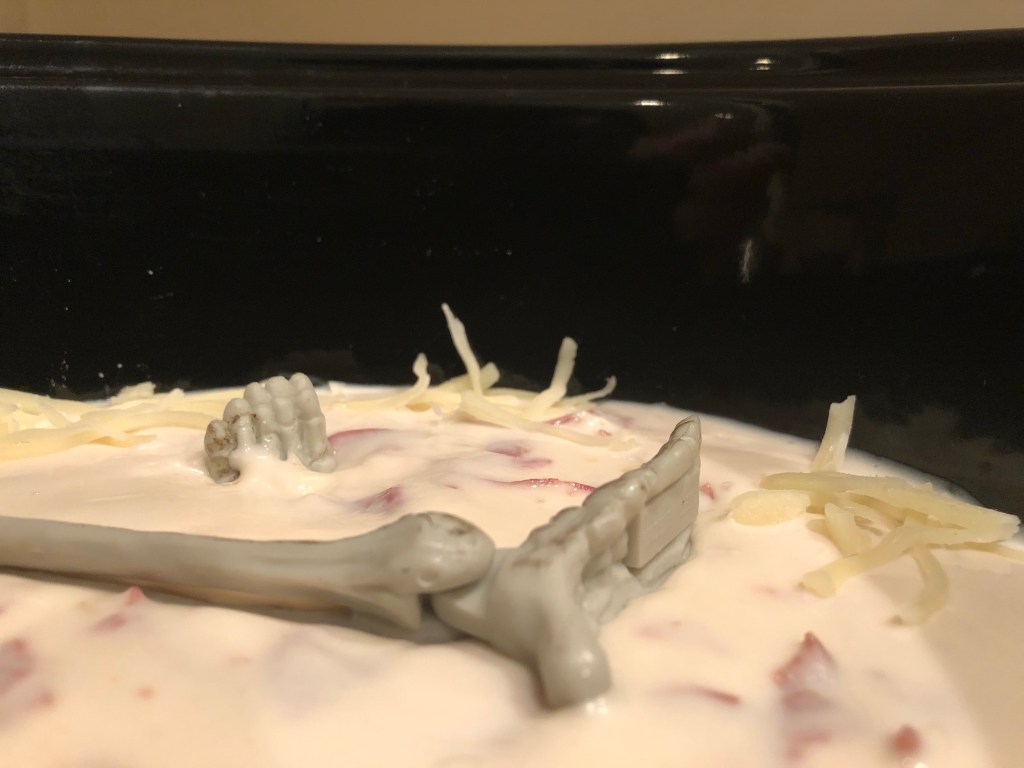
“Ah. That stumped me, too, until I looked again at our recipe. You’re supposed to reserve half the shredded cheese until the end, sprinkle it on top of the creamy chipped beef, and then serve it once the cheese has melted. Because the crock-pot wasn’t hot, the sprinkled cheese never melted. Yet, most of it was gone by the time we had arrived, except for some along the edges of the pot.”

img_2344-1
The shredded cheese on top didn’t melt, yet most of it was gone by the time they had arrived.

“I remember that, sir. But what does the cheese have to do with Jay Dee One?”

“It has everything to do with him, kid, because Dale swapped one for the other.”

“You mean?”

“Yes, Dale took the cheese because that’s what rats do. Rats take the cheese. But he had to put down the leg first, and that, kid, is how Jay Dee One ended up in the creamy chipped beef!”

“Hi-ho, the derry-o, Dale took the cheese! It all makes perfect sense to me now, sir!”

“Glad to hear it, kid.”

“But why would Dale have held onto that leg for almost a year and then abandon it for some shredded cheese?”

“Although we can predict a rat’s behavior, we can’t always understand its motives. Nor do we have to, necessarily. All we need to keep in mind is that a rat’s a rat, and that’s that. [Cf. William Shakespeare, Hamlet, Act III, scene iv.] Now that that’s all settled, it’s time to reveal our killer!”

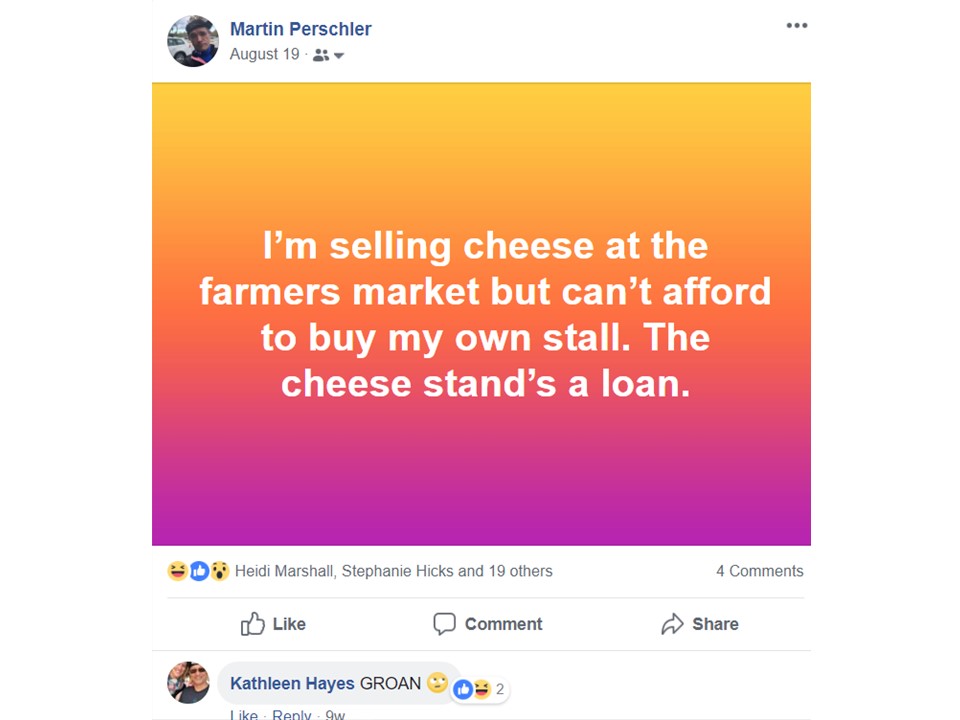
cheesestandsaloan.jpg

DOA, Chapter 22

img_2334

“But I don’t understand, sir. The guy with the crown at Bin 206 said they’d know if a bone went missing. They gave us their pickup info for Read and Ploy and everything.”

Review Bin 206’s records from October 2017

“Kid, the only way Bin 206 could have known if they were missing any bones in this case was if they’d gotten them in the first place. How many pickups did they have from the Read and Ploy location?”

“I can’t remember, sir. Three?”

“Four. How many bones does each of us have?”

“Two hundred and six, sir. Everybody knows that. It’s drilled into our skulls from the time we’re reborn.”

54751-120-7cba8be9
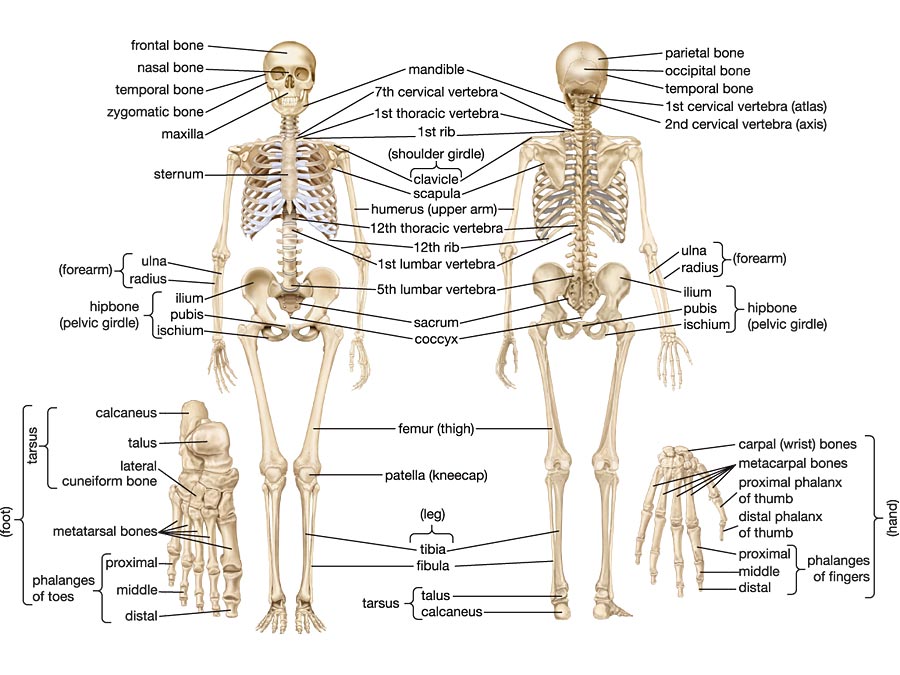
An adult human skeleton has 206 bones.  [Image credit: Encyclopedia Britannica, “human skeletal system”]

“Right. So, how many bones should they have logged that night from Read and Ploy, assuming they got four bags from there?”

“Let’s see. Four times two hundred and six is eight hundred and twenty-four.”

“Precisely. But the company only logged seven hundred and ninety-four, which meant they were thirty bones shy of a full skeleton. How many bones do we have in each of our legs?”

“Including the foot, sir?”

“Including the foot.”

“Well, let’s see. Femur, patella, tibia, fibula, plus the twenty-six in the foot makes thirty. Why, that’s our John Doe Number One! So, the left leg and foot from Read and Ploy never made it to the boneyard, and the yard didn’t notice because they’re only on the lookout for odd numbers. But what about Jay Dee Two? Where did he come from?”

“Ah, our red herring. He came from the prison factory where they make the dried beef. When I was shopping for the ingredients for the creamy chipped beef and cheese, I saw a recall notice posted on the shelf. Turns out, one of the workers got his foot caught in the beef chipper. Guess who got the lucky jar?”

img_2724
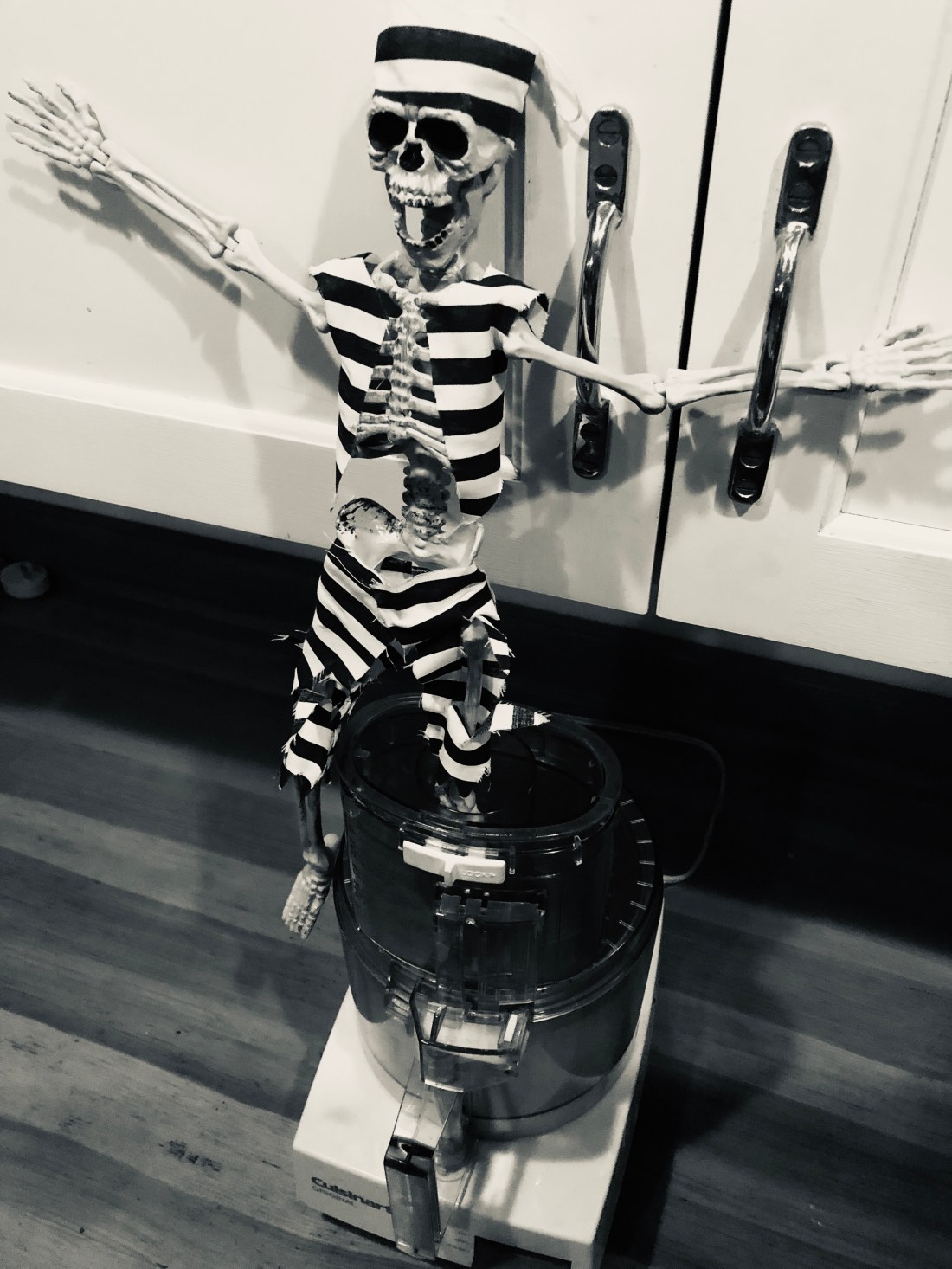
Prison factory worker loses left foot in beef chipper

“Gross! But what about the DNA match that led us to Butterscotch Chip, sir?”

“Lucky coincidence. You remember that the skeleton put out on the corner of Read and Ploy had been an afterlifelong donor, right? Well, the hospital used his marrow for Chip’s transplant last October, so Chip now carries his donor’s DNA. Hard to believe that we can carry someone else’s DNA from a bone marrow transplant, but it happens.”

“Huh. Why a lucky coincidence?”

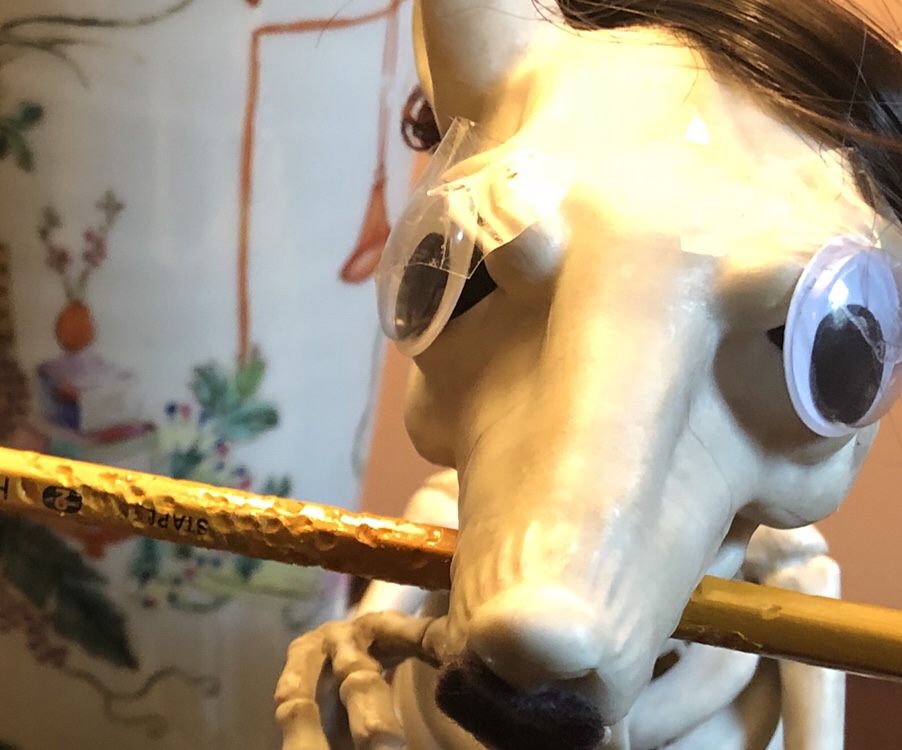
“Because the DNA ultimately led us to Chip’s rat sidekick, Dale. Did you notice the pencil in Dale’s mouth?”

“Yes, sir. I believe he was helping Chip with his poster for the bobbing for apples booth at the Halloween party.”

“No, he wasn’t, kid. Chip was using finger paints. He didn’t need a pencil. Besides, that pencil was full of teeth marks.”

img_2303-1
Dale often disguises himself as a googly-eyed Adolf Hitler. He also chews on things.

“Do you think Dale has temporomandibular joint disorder, sir?”

“Possibly. Or his mother waited too long to wean him when he was a pup. Regardless, he chews on things.”

“Are you suggesting, sir, that…?”

“That those abrasions and indentations on Jay Dee One’s lateral femur are teeth marks? Yes, that’s exactly what I’m suggesting. And I’m also suggesting that they’re Dale’s!”

DOA, Chapter 21

img_2336

“Let’s start with that recipe, kid. I couldn’t figure out why everything checked out except for the beef. The recipe calls for ground, yet ours was chipped. So, I went to the original version on the web, which said you could opt for traditional beef. I knew at that moment we had our recipe!”

“Gosh, sir. I didn’t even think to look.”

“Always go back to the source, kid. Clearly, they’ve got coding issues since the printable version doesn’t say anything about substitutions.”

“I’ll keep that in mind, sir.”

“Do you remember I had asked you about the setting on the crock-pot? I was hoping that we could construct a timeline of events based on the recipe settings.”

“I remember, sir. I’d said that I thought it was set on High but that it didn’t seem hot to me at all.”

“Right, which meant we couldn’t rely on the recommended cooking times.”

“Just like Martha Stewart’s lemon curd recipe, sir!”

“Exactly! She grossly underestimates the time required for the curd to set. I know of at least three people who’ve had to serve runny curd at parties because of her. Anyway, when we’d heard that the forensic archaeologist hadn’t found any more bones, I knew right then and there that at least some of the bones had been placed in the pot after Step 3 and that the crock-pot of creamy chipped beef and cheese wasn’t a crime scene but, instead, a dumping ground for bones.”

“Golly, sir. I never even thought of that. So, where did they come from?”

“From two very different places, kid.”

“What do you mean, sir?”

“You remember how the DNA results blew up our bad dancer theory, right?”

“Yes, which meant we had two John Does instead of one.”

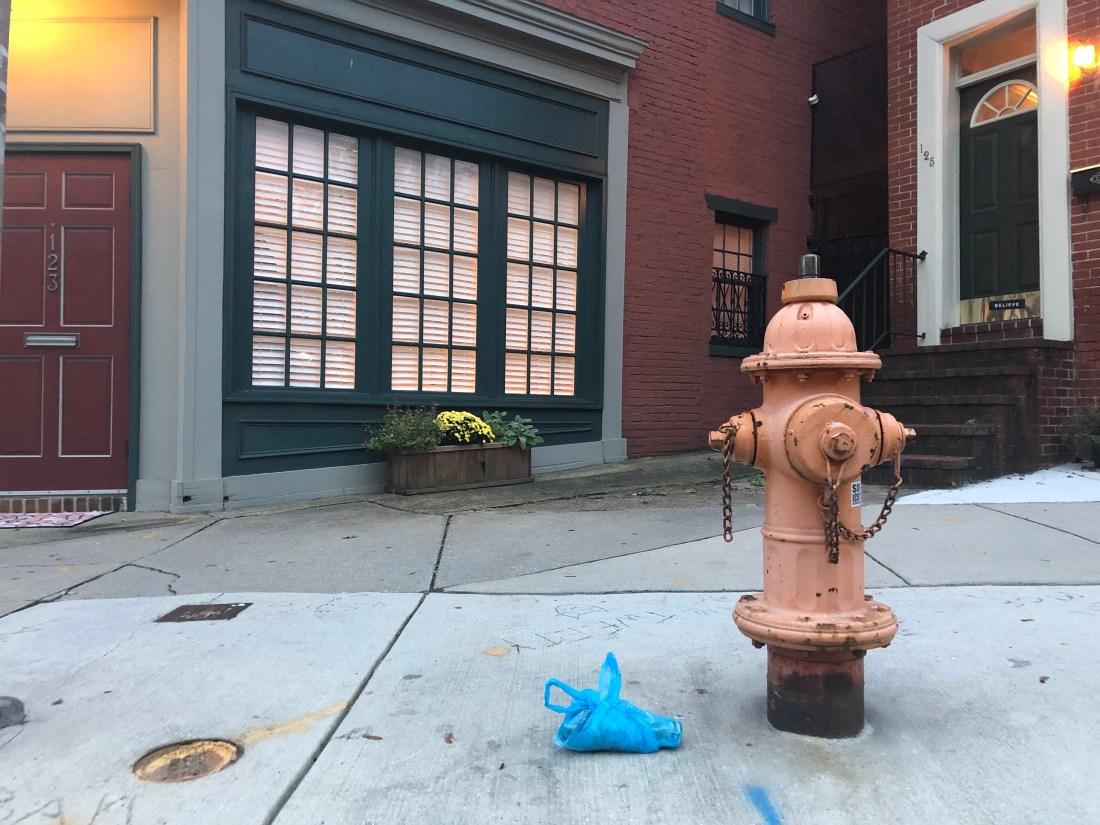
“Well, Jay Dee One came from the corner of Read and Ploy.”

img_2849
John Doe Number One came from the corner of Read and Ploy.

We’d like to thank the following non-paying advertiser for not sponsoring this chapter:

9780517544198-us