


Missy and Coco left the market area and headed for home. For the afterlife of her, Missy couldn’t figure out why someone so sensible and smart as Allie would have blindly sided with religion over science when confronted with a straightforward afterlife-or-second-death decision.
Months later, Missy learned something so disturbing she would’ve fallen apart had it not been for the amulet in her tiara that she had fashioned out of the single, perfectly-shaped semi-precious gem left at the site of Allie’s fatal spawning. During a routine dental visit, Dirty Rich the Clown Dentist (Missy Impossible, Chapter 5), while high on his own laughing gas, revealed to her that it was he who, disguised as a priest, had persuaded Allie to reject the advice of the ichthyologist and to spawn instead of have her gonads surgically removed to save her afterlife. He only did it, he said half jokingly, because he wanted to drill her.
Lying supine on the bed of leaves with her arms extended, Allie gave in to the agonizing pain radiating outward from her inguinal area to her caudal fin. “To be only half a monster is insanity!” she cried out, repudiating the only way she knew how and with what limited strength that remained her accursed hybrid condition and damned post mortem existence (cf. Victor Hugo, Notre-Dame de Paris, Book 8, Chapter 4). How did she not see it coming to this? What had she done during her previous lifetime to deserve her hellish afterlife as half skeleton, half mermaid? What perverse god in the heavens thought it just to hand down such a cruel and capricious punishment? Hers was no gift.
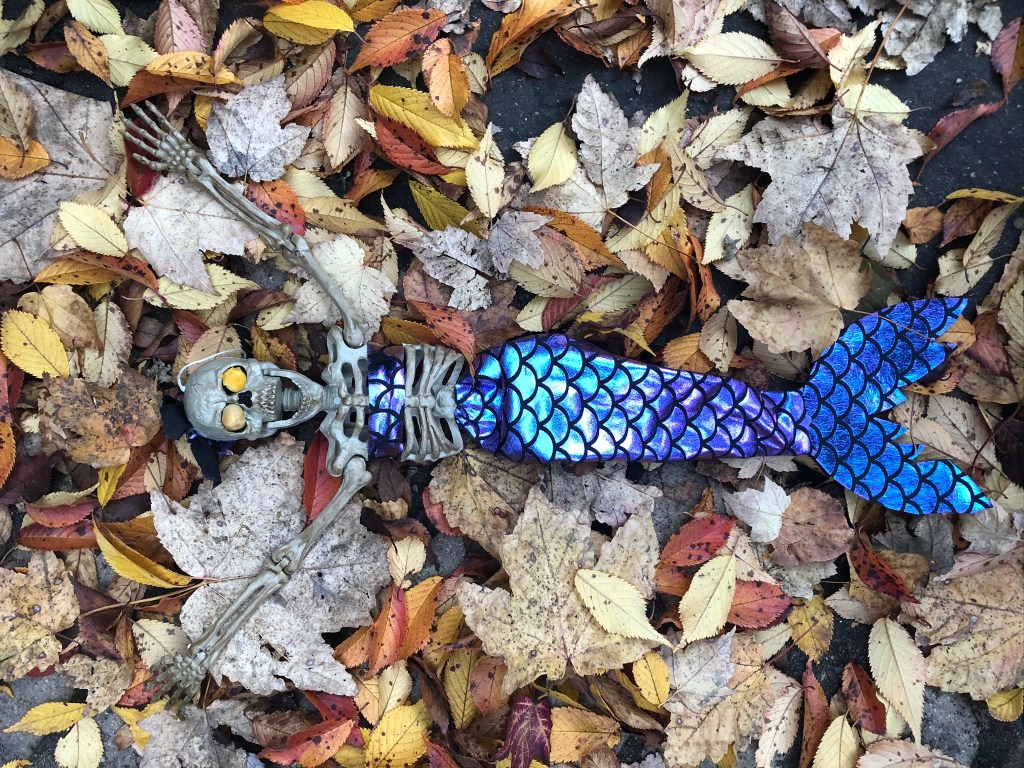
At that very moment, a searing pain around her anal vent overtook Allie so forcefully that her garbanzos popped out of their sockets. She started releasing what felt like fifty thousand and one eggs, all of them atretic and the last one of a crystalline composition more perfect and of an appearance more dazzling than centuries of alchemy and sorcery had ever produced. (No. 11)
Forsaken on her leaf mound which, dear reader (and there’s probably only one of you out there), covered the very spot where Allie’s parents had thawed and dislodged her from her icy manger years ago, Allie took one final breath and re-died. (No. 12)
At some point before dawn, the seafood vendor’s cat extricated Allie’s remains from the mound and carried them off, leaving her uninseminable eggs to the rats and the elements (No. 13). The vendor thanked his kitty for the gift and then buried Allie’s remains deep within the trash so that the cat couldn’t retrieve them. (No. 14).
Blind Allie’s Dolores Street (a.k.a. Way of Sorrows)
No. 1: Allie becomes aware that the time has come for her to spawn (4:3)
No. 2: Allie accepts her fate (5:1)
No. 3: Allie flounders for the first time (5:2)
No. 4: Allie sees her mother in a vision (5:2)
No. 5: A shopkeeper helps Allie advance towards the market by propelling her with the jet from his hose (5:2)
No. 6: A Veronica’s Unicorn Rental delivery van washes Allie’s face with a splash from a puddle as it passes her in the street (5:2)
No. 7: Allie flounders for the second time (5:2)
No. 8: Allie is lifted from the gutter by two women from town (5:2)
No. 9: Allie flounders for the third time (5:2)
No. 10: Allie is stripped of the skins covering her chickpea eyes (5:2)
No. 11: Allie releases her eggs (5:3)
No. 12: Allie dies on a mound of leaves (5:3)
No. 13: Allie is removed from the mound by the seafood vendor’s cat (5:3)
No. 14: Allie is buried in the trash (5:3)
“I’m trying to get to the market, but I’ve lost my way. Can you point me in the right direction?”
“It’s near State street at the end of Dolores street, downtown.”
“Can I get there via State?”
“No. Only via Dolores.”
Delirious from hunger, Allie floundered (No. 3). Although half Atlantic salmon, she had lost almost all sense of direction and could barely navigate the streets of her own town. Worse, visions of her mother kept dancing through her head like that mesmerizing gypsy girl from the book whose fate now seemed intertwined–but hardly completely–with her own (No. 4). If it weren’t for the shopkeeper who had propelled her and some litter along the street gutter with the jet from his hose, she wouldn’t have made it to the market (No. 5).
Lying face up in the gutter on Dolores at the entrance to the market, Allie felt the invigorating splash of cold water across her frontal bone courtesy of a passing Veronica’s Unicorn (both foreign and domestic) Rental delivery van (No. 6; cf. Missy Impossible, Chapter 10). Her mind drifted back to those sweet moments in the pool with her teammates, which now seemed out of reach like hazy distant memories.
Physically exhausted, Allie floundered a second time (No. 7). Never before had she experienced such lethargy in her tail and throughout her bones. She could barely advance, let alone jump the curb to enter the market.
Suddenly, as if by some magical force, she rose above the level of the curb and floated northward into the market space where, upon reaching some fateful point, she was laid to rest onto a bed of wet decaying leaves. “That’s good enough, Coco,” she heard a vaguely familiar voice say. “That fish’s going nowhere” (No. 8).
Immobilized both emotionally and physically on that cold and damp bed of leaves, Allie, having floundered for the third time, started to cry (No. 9). Those impermeable translucent skins that had been her secret weapon in the pool for so long but that, she came to realize, had also clouded her vision, detached from her big garbanzos and fell forever from her eyes (No. 10).
“Swear to God, Allie. I sometimes wonder if you have a brain.”
“None of us does, Missy. That’s the point. Why would I listen to a fish biologist when no scientist can explain how we are able to exist without a brain or any other organs?”
Allie had made up her mind, and nothing Missy said was going to change it. She wasn’t going to have her gonads removed. Instead, she was going follow the counsel of her priest and accept the sensation in her inguinal area as another gift and a heavenly sign that she had entered the labyrinth.
She couldn’t put her boney finger on the trigger, though summer had recently turned to fall and, for reasons she couldn’t explain, she had pretty much stopped eating. And then there was the urge to run up to the spot between the seafood and legume stands at the market where her parents found her so many years ago. Weakened from the lack of food, she surrendered to it, having persuaded herself that the urge was a divine calling (No. 2).
“You’re sure? Okay, thanks.”
Lacking entrails, Allie digested the results from the ichthyologist as best she could. She was part Atlantic salmon. But the news of her ancestry paled in comparison to the ichthyologist’s other observation. Tissue- and organ-less above the waist, Allie had no pituitary gland, so any sensation she might have been experiencing in the inguinal area during sleep, in the ichthyologist’s estimation, had nothing to do with ovulation. Instead, it was likely symptomatic of something else and potentially fatal. He urged her to have her gonads removed.
Unlike the ichthyologist, Allie’s priest viewed her situation differently. How does science explain the fact, he asked her pointedly, that she and other skeletons could walk, talk, eat, pray, love, swim, and do all other sorts of things without the nerves, muscles, heart, brain, and all the other vital organs and tissues that scientists have insisted for ages were essential for life? Faith alone, he counter-insisted, sustained them in the afterlife. Perhaps the sensation in her inguinal area was God telling her that the time had come for her to spawn (No. 1). She was part Atlantic salmon, after all. Who was she to ignore his plan?
“Oh God. Esmeralda had a dagger. I have to finish that book.”
The bottle of Blue Nun nearly emptied, Allie lay back on the chaise lounge and reflected next on the last several months of her life. She proceeded contemplatively through the most pitiful chapters, from her arousing nightmare of just under an hour ago, through the humiliating publication of her two cathedral drawings, to the equally humiliating night on stage as Julie La Verne in a tub. Her reflections eventually led her back to where her secret evolving narrative had begun–on that pathetic bed of ice between the seafood and legume stands at the market.
She never really thought much about piecing together the story of her life prior to that day her parents had rescued her or about finding her biological merfolk. With over 30,000 species of bony fishes in her class (Actinopterygii, from the Greek πτέρυξ [ptérux ‘wing, fins’]), she wouldn’t even know where to start. Besides, what if she discovered something she didn’t want to know, like she’s descended from a school of blobfish? She was nothing but bones above the waist, so there was little way of knowing anything about her origins without consulting an expert. If it turned out that she herself was part blobfish, her dreaded transformation into the Quasimodo of her generation would be complete.
But something deep inside her–not in her inguinal area, which had already had enough stimulation that evening, but somewhere else–was telling her that the time had come to trace her ancestry. She leapt off the chaise using the full force of her tail and made her way back to her bedroom with a plan. First, she’d see an ichthyologist. Then, she’d talk to her priest.

“Damn those Bible study freaks and their Latin!“
Allie sat up so forcefully that her garbanzos nearly popped out of their sockets. Jolted awake by a nightmare, she now found herself alone in her bed covered in a slimy cold sweat, her fishtail twitching convulsively under the sheet that in the murky predawn light of her bedroom took on the mesmerizing appearance of an oscillating water wave.
Just a moment earlier she had been chained to a fish cleaning table in Vulcan’s fiery mythical forge where, through alchemy or some other dark art, the archbishop of Paris had magically transformed the metal 19th-century spire of Notre-Dame into a brilliantly bejeweled burning hot silver misericorde (also known as a mercy dagger) that spun threateningly on its point at the most intimate and sensitive point on Allie’s inguinal area. She didn’t know whether she was about to be fileted or transformed into a biped like the Little Mermaid. She didn’t want to find out either, which is why she forced herself awake.
A craving for Blue Nun overtook her. She got up, went to the kitchen, and grabbed one of her father’s bottles from the refrigerator. She poured herself a glass, sat down, and took a sip, hoping the wine would help her figure it all out.
“I’ll have the gazpacho.”
“Just an iced tea for me, thanks.”
“Hey, Allie, isn’t that your Paris cathedral drawing?”
“Where?”
“Over there. On the front page of the local rag.”
Allie grabbed the newspaper that a customer had left on the adjacent table and abruptly sank back into her banquette, stunned by what she saw. So beyond mortified, she nearly fell apart.
Above the fold on the front page was not her one, but her two entries to “Draw me Notre Dame,” scandalously decoupaged and outrageously captioned, “Local Teen’s Burning Desire Receives Honorable Mention.”


She thought she had given clear instructions. When the archbishop wrote to her about the delayed honorable mention, he also sent a copy of his letter to the local paper, along with a press release and background on the project. Soon after Missy had pointed out Allie’s lewd placement of the spire, Allie sent the paper’s dead editor-in-chief an image of her second entry–which did not receive any mention but also did not cross any moral lines–with instructions to use the church on fire rather than the church with the spire if the paper was going to print anything about it.
The paper’s boneheaded typesetter literally took Allie’s instructions as relayed via the editor-in-chief literally and superimposed her drawing of the church on fire on the church with the spire, leaving the Blessed Virgin Mary mostly unaltered, except now her groin was engulfed in flames.
“I’ve seen better ribs at a barbecue.”
“I’m sorry, Missy. What was that?”
Allie was so preoccupied with the current SAGS saga that she completely missed Missy’s latest slam at their rival swim team.
Today’s news was not good. According to the reports, SAGS deniers in a neighboring town have taken to throwing buckets of boiling water at unsuspecting passersby and mocking SAGS believers for believing what they’re convinced is a dastardly plot to prop up the refrigeration industry at the heating industry’s expense. Now, cases of SAGS are skyrocketing, skeletons of all ages are falling apart, the town’s boneyard is beyond capacity, and HVAC technicians don’t know which side to support.
To make matters worse, Bin 206, the company that manages the yard and many others in the tri-state area, is calling off negotiations with the union, stating that the talks have become too heated and that both sides need some time away from the bargaining table to cool down, for their own survival if for nothing else (Dead on a Rival, Chapter 9 and Chapter 10).
The schism caused by the SAGS-19 pandemic was engulfing nearly every aspect of daily life. Skeletons who once ate and drank together were now assiduously assorting themselves by seemingly inconsequential food and beverage preferences: cold soups and salads versus hot, mild versus spicy salsas, chilled white wines versus reds served at room temperature, etc., etc. No one dead could recall an earlier time of such tribalism and heightened in-group bias.
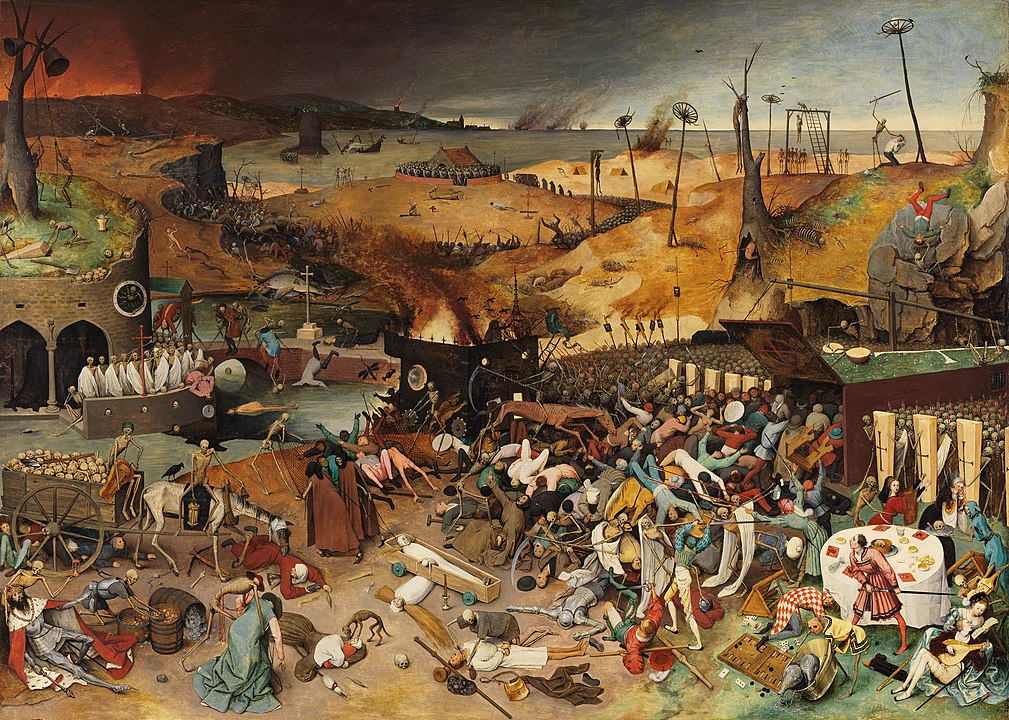
Animus towards the Other was even poisoning the Arts. Once a popular and powerful expression of unity across classes in the afterworld, the Danse Macabre had all but disappeared from country club and beer garden alike because believers and deniers couldn’t agree on who should lead and who should follow. And at the Museum of Art tempers were flaring and rifts widening over the fate of the museum’s most prized possession: Pieter Bruegel the Skelder’s super-sized diptych of Pieter Bruegel the Elder’s 16th-century masterpiece, “The Triumph of Death.”
For centuries a touchstone of pan-skeleton identity, the diptych was now dividing the community into two rival camps, one hell-bent on praising the work as an archetypal representation of the glorious and inevitable victory of the dead over the living and defending its place in the museum, and the other equally hell-bent on condemning it for its heartless depiction of corporeal antipathy and glorification of mass genocide and calling for its removal.
No sooner had Allie fixed her focus on the diptych controversy than a news alert about it popped up on her phone. The museum’s curators had just saved—allegedly by the skin of their teeth, but Allie had her doubts about the skin part—the diptych from an almost painfully certain deaccession and most certainly painful disassembly. To appease both sides, they had successfully concocted a plan to preserve the diptych intact in the museum but to interpret it in the historical context of the bubonic plague, which had arrived in Flanders at the turn of the 15th century. They knew the plague connection was a stretch but figured that the public was too boneheaded to figure it out.
 Mr. Funny Bones