

“I’ve seen better ribs at a barbecue.”
“I’m sorry, Missy. What was that?”
Allie was so preoccupied with the current SAGS saga that she completely missed Missy’s latest slam at their rival swim team.
Today’s news was not good. According to the reports, SAGS deniers in a neighboring town have taken to throwing buckets of boiling water at unsuspecting passersby and mocking SAGS believers for believing what they’re convinced is a dastardly plot to prop up the refrigeration industry at the heating industry’s expense. Now, cases of SAGS are skyrocketing, skeletons of all ages are falling apart, the town’s boneyard is beyond capacity, and HVAC technicians don’t know which side to support.
To make matters worse, Bin 206, the company that manages the yard and many others in the tri-state area, is calling off negotiations with the union, stating that the talks have become too heated and that both sides need some time away from the bargaining table to cool down, for their own survival if for nothing else (Dead on a Rival, Chapter 9 and Chapter 10).
The schism caused by the SAGS-19 pandemic was engulfing nearly every aspect of daily life. Skeletons who once ate and drank together were now assiduously assorting themselves by seemingly inconsequential food and beverage preferences: cold soups and salads versus hot, mild versus spicy salsas, chilled white wines versus reds served at room temperature, etc., etc. No one dead could recall an earlier time of such tribalism and heightened in-group bias.
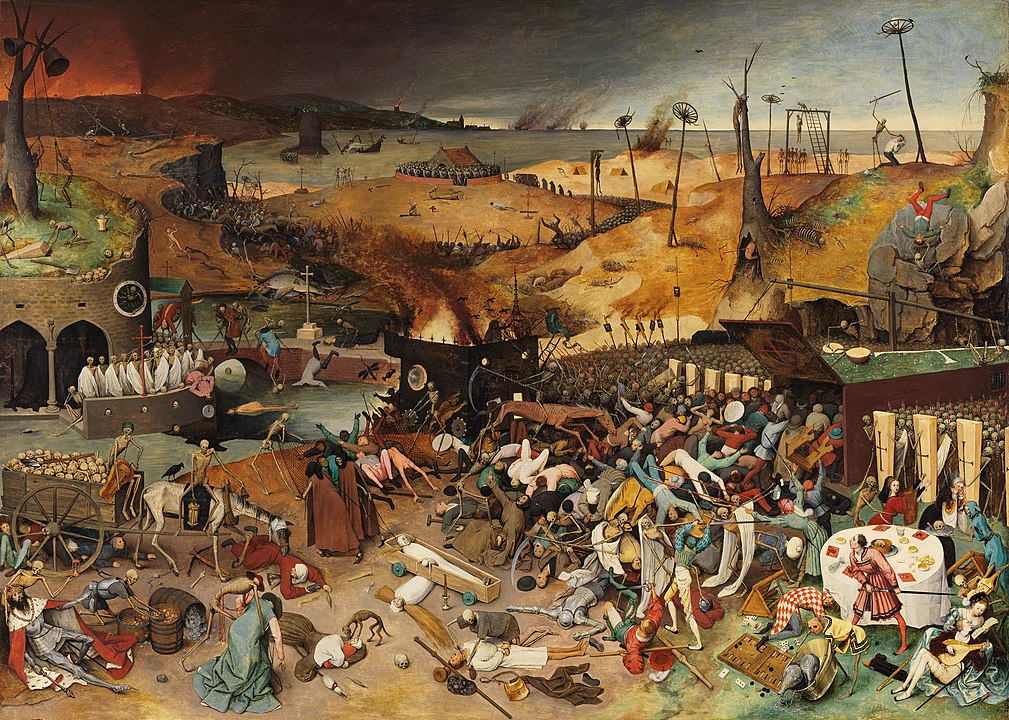
Animus towards the Other was even poisoning the Arts. Once a popular and powerful expression of unity across classes in the afterworld, the Danse Macabre had all but disappeared from country club and beer garden alike because believers and deniers couldn’t agree on who should lead and who should follow. And at the Museum of Art tempers were flaring and rifts widening over the fate of the museum’s most prized possession: Pieter Bruegel the Skelder’s super-sized diptych of Pieter Bruegel the Elder’s 16th-century masterpiece, “The Triumph of Death.”
For centuries a touchstone of pan-skeleton identity, the diptych was now dividing the community into two rival camps, one hell-bent on praising the work as an archetypal representation of the glorious and inevitable victory of the dead over the living and defending its place in the museum, and the other equally hell-bent on condemning it for its heartless depiction of corporeal antipathy and glorification of mass genocide and calling for its removal.
No sooner had Allie fixed her focus on the diptych controversy than a news alert about it popped up on her phone. The museum’s curators had just saved—allegedly by the skin of their teeth, but Allie had her doubts about the skin part—the diptych from an almost painfully certain deaccession and most certainly painful disassembly. To appease both sides, they had successfully concocted a plan to preserve the diptych intact in the museum but to interpret it in the historical context of the bubonic plague, which had arrived in Flanders at the turn of the 15th century. They knew the plague connection was a stretch but figured that the public was too boneheaded to figure it out.
 Mr. Funny Bones
One thought on “Blind Allie 2:3”