

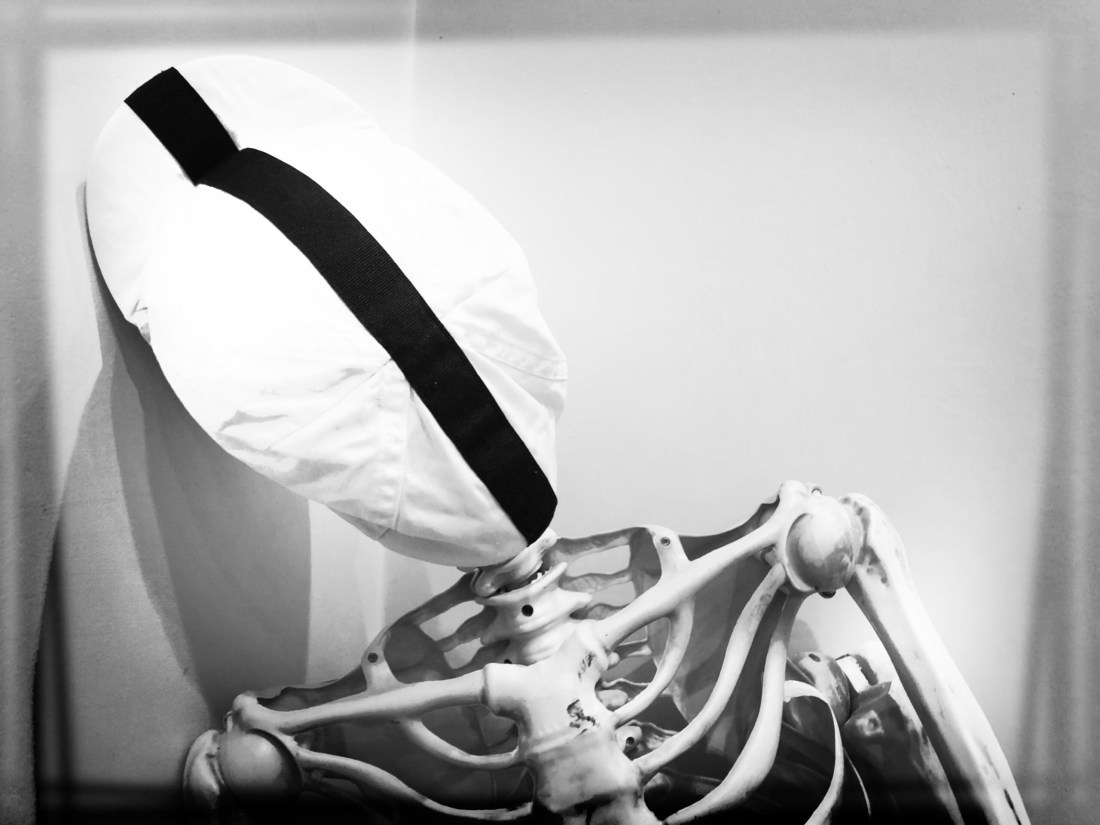
“Stop laughing at me!” Little Hope shouted at the two large skeletons propped up in the corner of her bedroom. They didn’t listen, so she sprang from her bed, grabbed the cycling cap off Mr. Funny Bones’s skull and, holding it by the visor, hooked the cap under his jaw and pulled it over his frontal bone, fully covering his face. She repeated the brutal process on Funnier. “That should shut you both up for a while,” she said scornfully.
She never should have gone into the shed. She hadn’t been inside it for months, from the moment her mother put a lock on it, and she wanted to ride her bicycle again. After several unsuccessful attempts, including a couple tantrums, she took advantage of a lapse in protocol–her mother had left the shed unlocked–and went in to get it herself.
To the left of the spot where her mother stored the lawnmower hung Uncle Mack’s road bike. Although covered in dust and its tires deflated, the bike looked just as Little Hope remembered it. Beneath Uncle Mack’s bike, stacked on the wooden floor like a pile of bones, were the barely recognizable mangled wheels and shattered carbon frame of what used to be her father’s.
The last time Little Hope had seen her father and his bicycle, both were intact. Although Little Hope’s mother had explained the accident to her and Johnny in general terms, she had withheld the details and the horrific evidence of it from her children. The sight inside the shed laid bare for Little Hope the violence and inequity of her father’s and Uncle Mack’s final moments.
After that trip to the shed, everything having to do with Uncle Mack degenerated into a source of torment for her. The toy skeletons, the stuffed animals, the pictures of the places he had visited–even the nicknames like Only Street that had become part of her family’s lexicon–fed an incipient rage and enveloping sorrow. She felt as if she were trapped underwater, drowning in her own bedroom. Not even her spirit animal could rescue her.
Lying on her bed exhausted after a turbulent cry, Little Hope stared at the cloud drawing on her ceiling. Her mind drifted to that one evening at Simpson’s Garage when, instead of Herbie Goes Bananas, Jake ended up showing the movie, Poltergeist, because of a mix-up at the video rental store. She distinctly remembered the quirky little woman with the teased hair, Tangina, who had been brought into the house to rid it of its demons.
In the movie, Tangina delivered many memorable lines that Little Hope, Uncle Mack, and her family would repeat jokingly whenever a situation warranted them. Those lines weren’t so funny anymore. She hoped that her father and Uncle Mack had remembered to step into the light and that they had found serenity and peace there.
After nearly six months’ worth of conversations with the Kellers, Selters, Mr. Lewis, and Mrs. Smith in the cemetery, it had finally dawned on her that they weren’t trapped underground. On the contrary, they were free. They had simply transitioned from one state of being to another. The transition might have involved agony. It might have happened quietly. The burden and the pain of adjusting to the holes that had formed in their wake fell to those they had left behind.
For a fleeting moment, she felt ancient for her age, as if taken over by an old soul that had witnessed the passage of a thousand lifetimes. Reflecting with frightful clarity on her short life, she had, in fact, caught glimpses of what that burden looked like in her mother, her grandmother, Jake Simpson, and even in Mr. Smith, for whom the arc of adjustment seemed tragically long. She just hadn’t recognized it at the time for what it truly was. She got up from her bed and went over to her mirror to see if she, too, now bore the signs of that burden in herself.
 Mr. Funny Bones