


Even by a child’s standards, the village of Greenfield was small, and Little Hope knew every corner of it.
South of the cemetery barely stood Mr. Smith’s barn, a pitiful yet picturesque Dutch gabled remnant of a farm that once extended eastward for several acres from Only Street. The barn’s tar-papered and asphalt-shingled roof slumped a bit towards the middle and reminded Little Hope of old Mr. Smith himself every time she passed it.
Although she had yet to see for herself, she had heard that in the barn sat Mr. Smith’s rotted old Lincoln Town Car, which he had not driven, let alone touched or looked at, since his wife had died over thirty years ago. The word on the school bus was that Mr. Smith had buried his wife’s corpse in the trunk and that on certain Sundays during the year you could hear a mysterious knocking coming from inside the barn. Little Hope figured the source of the noise must be a loose board since she talks to Mrs. Smith weekly in the cemetery.
Little Hope’s grandmother couldn’t confirm that the barn was, in fact, haunted, but she did remember seeing the Smiths together in the car on Sunday mornings on their way to church. Mrs. Smith always sat in the back seat, which Little Hope couldn’t understand because, based on her experience, the passenger seat in front was the next best thing to being behind the wheel.
Although thirty years had passed since the death of his wife, Mr. Smith didn’t seem bitter or reclusive. He just didn’t go into that barn. He walked around it everyday, though, to check on his Buff Orpingtons or to replace the small American flags on the posts of the surrounding chicken-wired wooden rail fence with new ones or holiday decorations depending on the season. Although her schoolmates dismissed Mr. Smith as a crazy and miserable old man, Little Hope felt he had a kind and generous heart, and she never forgot the time when he gently applied mud to a bee sting on her arm. So much better, she thought, than the meat tenderizer her grandmother had tried to force on her another time she had gotten stung.
Down from the haunted car barn stood Jake Simpson’s Garage, one of two businesses in all of Greenfield. After the cemetery, Simpson’s was the only place on Only Street approaching anything close to a landmark, mainly because of the striped and numbered ‘70s Volkswagen Beetle permanently parked out in front between the garage and Jake Simpson’s house next door. The garage was more of a hobby than a business for Jake, considering the very few clients he had and the even fewer passersby on Greenfield’s single, dead-end street, but the cars and pickups parked in front and around the side of the garage gave the place the appearance of a viable operation. Jake made most of his money plowing driveways and side roads in the winter and hauling away junk the rest of the year.
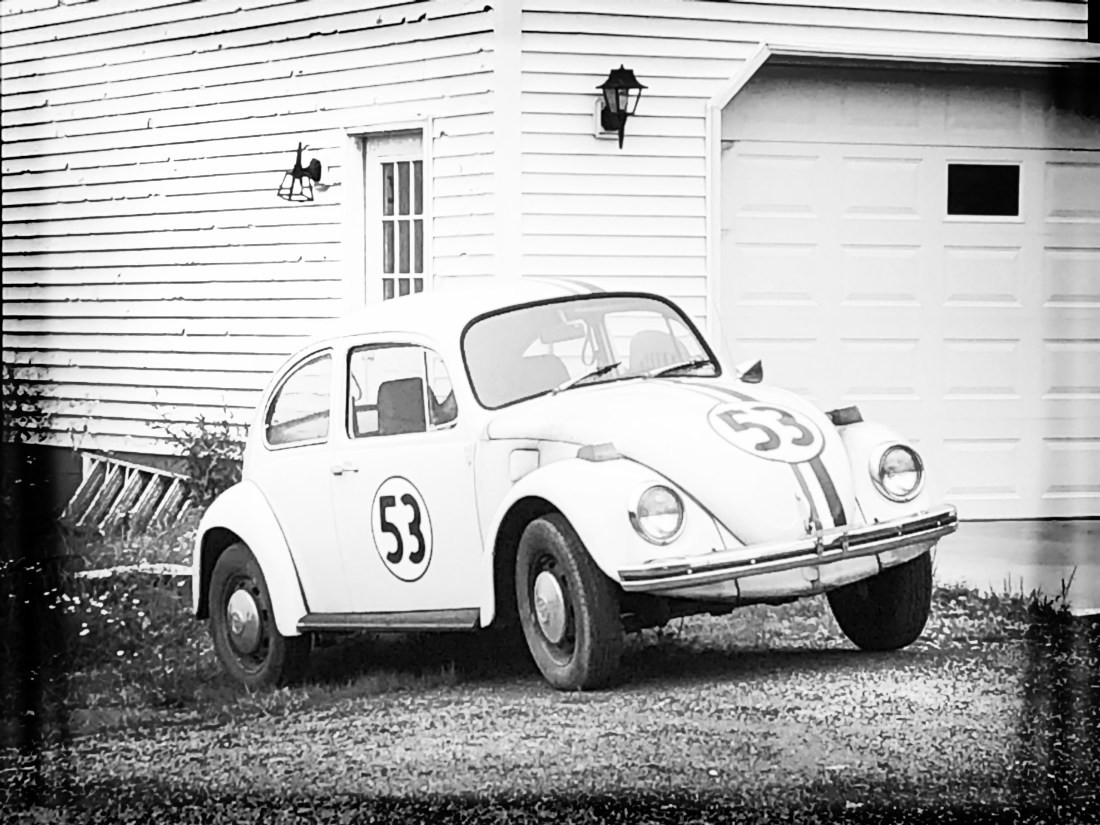
Pretty much everybody in the township called the Beetle the “Love Bug.” Little Hope’s parents’ and grandparents’ generations were old enough to remember the many Walt Disney movies starring the cheerful anthropomorphic car. Her generation, or the kids in the township high school mainly, called it the Love Bug because they used it, or they tried to at least, as an out-of-the-way, after-dark location for making out.
Little Hope had all the Herbie movies memorized. Some time ago, someone in Greenfield had persuaded Jake to transform the side of his garage into an outdoor movie screen during the summers for free viewings of all the films in the series. People came from all over the township to watch, including the area teens, though Little Hope had overheard that most of them used the occasion to figure out how to break into the Beetle.
Anyone who knew Jake would have expected to find a corpse hidden in it. Little Hope had it on good authority from an older schoolmate, however, that the front trunk contained little more than the spare tire and some faded and water-warped copies of dirty magazines.

Across Only Street from Simpson’s Garage and completing Greenfield’s commercial core was the basket factory. Little Hope knew it well because her grandparents had owned and operated it since before she was born. The Lively Basket Company served the local market gardeners and truck and grape farmers equally, with lines of wooden bushel, peck, and harvest baskets, some with wire handles and lids, to suit their clients’ different needs and budgets.
Little Hope’s grandfather was far more conservative than innovative in his approach to basket making, which the company’s radio and TV ads featuring the Andrews Sisters’ version of “A Bushel and a Peck” from the musical, Guys and Dolls, reinforced to a mind-numbing degree. Her grandmother preserved that tradition as a memorial to her husband after he died.
A small operation, the Lively Basket Company employed twenty-five people, most of whom lived in the nearby towns. The company had only a few Greenfield residents on the payroll. As much as she respected her neighbors, as “chief cook and basket weaver,” as Little Hope’s grandmother liked to say, she refused to hire them just because they lived on the same street. She also didn’t want to become too friendly with any of them because chumminess, she’d always say, breeds gossip. Instead, she supported the people of Greenfield in other ways, mainly by sponsoring the Herbie the Love Bug film festival each summer on the side of Simpson’s Garage.

Little Hope’s grandmother lived in the red and white house between the factory and the Klinghoffer farm. Situated on a slight rise from Only Street, the house was hardly a mansion but, due to her grandfather’s industriousness and her grandmother’s insistence, it had an aura of respectability about it, from its neatly organized and manicured lawn to its fresh asphalt-shingled roof. Whenever she went there, which was fairly often, Little Hope felt like a princess because it was, by all accounts, the nicest house in the village.
Inside, Little Hope’s grandmother’s house was everything one would expect based on the outside. It was crisply painted, nicely furnished, and uncluttered. “It looks like nobody lives there,” Little Hope’s mother once said. “It’s so clean! Unlike our house,” Little Hope replied. Although she didn’t have to take off her shoes and could play in the living room so long as she stayed off the furniture, Little Hope would tip-toe around her grandmother’s house and take extra care when touching or moving anything, down to a kitchen chair. That’s how palatial her grandmother’s house seemed to her.
She didn’t have her own room at her grandmother’s, but she and Johnny treated the spare bedroom as their own and took turns sleeping over at the house. The room had two twin beds with multicolored floral chenille bedspreads, separated by a light birch wood nightstand that matched the dresser on the opposite wall. It didn’t have any toys or stuffed animals, and, other than a couple framed photographs of Little Hope’s mother as a teenager and an old-fashioned tinted photograph of some ancient relatives, the lilac-colored walls were free of decorations. Nothing about the room resembled Little Hope’s own bedroom, but its differentness was a large part of its appeal. At the end of nearly every sleepover, Little Hope would tell her grandmother not to change a thing.
 Mr. Funny Bones
One thought on “Little Hope, Chapter 5”